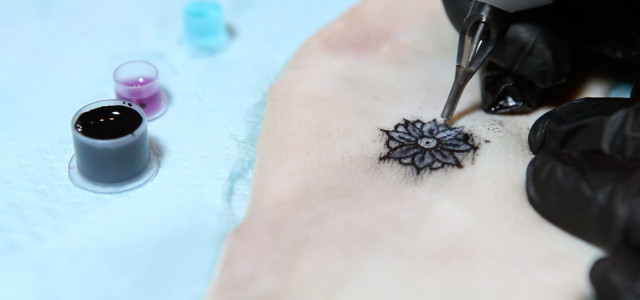
The Dermal Abyss
Can tattoos embrace technology in order to make the skin interactive? The DermalAbyss project is the result of a collaboration between MIT researchers Katia Vega, Xin Liu, Viirj Kan and

Director of the Interactive Organisms Lab
Can tattoos embrace technology in order to make the skin interactive? The DermalAbyss project is the result of a collaboration between MIT researchers Katia Vega, Xin Liu, Viirj Kan and
http://dl.acm.org/citation.cfm?id=2890270
Beauty Technology is a wearable computing paradigm that uses the body’s surface as an interactive platform by integrating technology into beauty products applied directly to one’s skin, fingernails and hair.
Our aim is to use our own bodies as an interactive platform. We are trying to move away from traditional wearable devices worn on clothes and accessories where gestures are
Our aim with Beauty Technology is to transform our body in an interactive platform by hiding technology into beauty products for creating muscle based interfaces that don’t give the wearer
As wearable technology assumes an increasingly important function in daily life, sensors and other electronic devices applied directly to the skin, in forms like artificial nails and makeup, might further
Looking for wearables that are fashionable, smart and augment human interaction, we introduce the term Beauty Technology as an emergent field in Wearable Computing. It is an on-body computing approach
Este artigo apresenta uma abordagem sistemática de prototipação colaborativa para a criação de tangíveis. Durante quatro períodos letivos, esta abordagem foi aplicada em uma disciplina para calouros de Engenharia, na
Wearable Computing had changed the way individuals interact with computers, intertwining natural capabilities of the human body with processing apparatus. But most of this technology had been designed just for
Just blink and levitate objects, just move your fingernails and open the door. Chemically metalized eyelashes, RFID nails and conductive makeup are some examples of Beauty Technology products, an emergent
The evolution of Wearable Computers is making it possible for wearers to move and interact freely with the world with nearly invisible technology embedded into clothing. Our aim is to
Imagining the future, we create sci-fi predictions visualized through telematic imagery, involving stage sets and costumes. Looking back at sci-fi’s imagination we find it depicts the ideologies of the period
The Cybernetic Serendipity exhibition in 1968 [1] and the Computer in Art book in 1971[2] represent some remarkable initial approaches in collaborative art-technology projects. Over the years, projects have evolved
Touch, sight, smell, hearing and taste – our senses link us to the outside world. Reflexes react to all stimuli arriving simultaneously to our sensory environment. But there are lapses
The main motivation of this research is to gain a better understanding of the power of feedback loops by finding the zone somewhere between passively offering information and aggressively pumping
During the last 5 years, research on Human Activity Recognition (HAR) has reported on systems showing good overall recognition performance. As a consequence, HAR has been considered as a potential
This paper describes a systemic approach to co-design of collaborative museums, using ethnography, co-creation workshops and fast prototyping, amongst other Social Science and Human Centered Design methods. Focused on the
Este artigo apresentada a arquitetura xAgent, cuja finalidade é o desenvolvimento de ambientes cross-reality colaborativos. xAgent se baseia em um sistema multiagentes no qual a comunicação entre os agentes se
This paper presents xGroupware, a cross-reality application to support distance group work, in which some activities related to the coordination of meetings are systematized. xGroupware was developed with a Multiagent
The paper presents a human centered approach to co-design of groupware and socialware for collaborative museums, using ethnography, co-creation workshops and Blank Model Prototyping. It discusses the concepts and processes
This position paper outlines the authors’ vision on how the Web of Things, using interconnected devices, including sensor nodes, mobile phones and conventional computers can help improve the overall health
This paper presents xGroupware, a cross-reality meetingware that coordinates some activities to support remote workgroup. xGroupware was developed based on a multiagent system architecture that integrates different technologies for enabling
TREG is a training game which simulates various activities in software requirements workshop technique based on the book “Requirements by Collaboration”. It was developed in Second Life, a virtual world
TREG is a game for training in Requirements Engineering, specifically in the Workshops technique. It was created in Second Life using its building and scripting possibilities. This works presents an
This work presents a collaborative educational game,Time2Play, developed in Second Life, which allows t he creation ofstories in a collaborative fashion, offering a new form of expression in education. This